When Time Stops Behaving: AI, Organisations, and the Problem of Misaligned Time
Most discussions about AI focus on capability — what it can do, how fast it's improving, and where it might go next.
My last post focused on the fact that less attention is paid to something more subtle, but arguably more disruptive.
Time.
Not just in the sense of speed, but in how time is experienced across different parts of a system.
Because one of the emerging challenges is that time is no longer behaving consistently.
Three distortions of time
There’s a useful way to think about this through the lens of Christopher Nolan’s films, which tend to explore different distortions of time.
Each highlights a failure mode that is starting to appear in organisations.
Memento - shrinking context
Memento is, from one perspective, about the loss of reliable context.
The protagonist can only operate within a short window before information becomes unreliable. Decisions are made based on fragments. Intent has to be reconstructed repeatedly.
That starts to feel familiar.
As AI accelerates the rate of change, the “half-life” of assumptions shortens. Decisions that would previously remain valid for years may now only hold for months, or less.
- Roadmaps decay
- Architectural decisions need revisiting
- Context becomes harder to rely on
We are not operating without memory, but we are operating with a shrinking window in which that memory remains reliable.
Inception - layered time
Inception introduces a different problem.
Multiple layers, each moving at a different speed. Coherence depends on keeping those layers aligned.
Organisations are starting to experience something similar.
- Strategy evolves on one cadence
- Delivery operates on another
- Tooling and AI capabilities shift on a third
Each layer is internally consistent. The problem is alignment.
You can have:
- A strategy that assumes stability
- A delivery system optimised for throughput
- A tooling layer that is evolving weekly
And they drift.
Not because any single layer is wrong, but because they are not synchronised.
Interstellar - asymmetric time
Interstellar takes this further.
Time does not just move at different speeds. It becomes fundamentally asymmetric. Hours in one context translate to years in another.
This is where the parallel becomes more direct.
Different parts of modern organisations now experience time at different rates:
- AI and tooling → fast time
- Delivery → medium time
- Capability development → slow time
- Organisational change → very slow time
Decisions made in one frame do not translate cleanly into another.
A strategic plan created in “slow time” may already be misaligned with a “fast time” environment by the time it is executed.
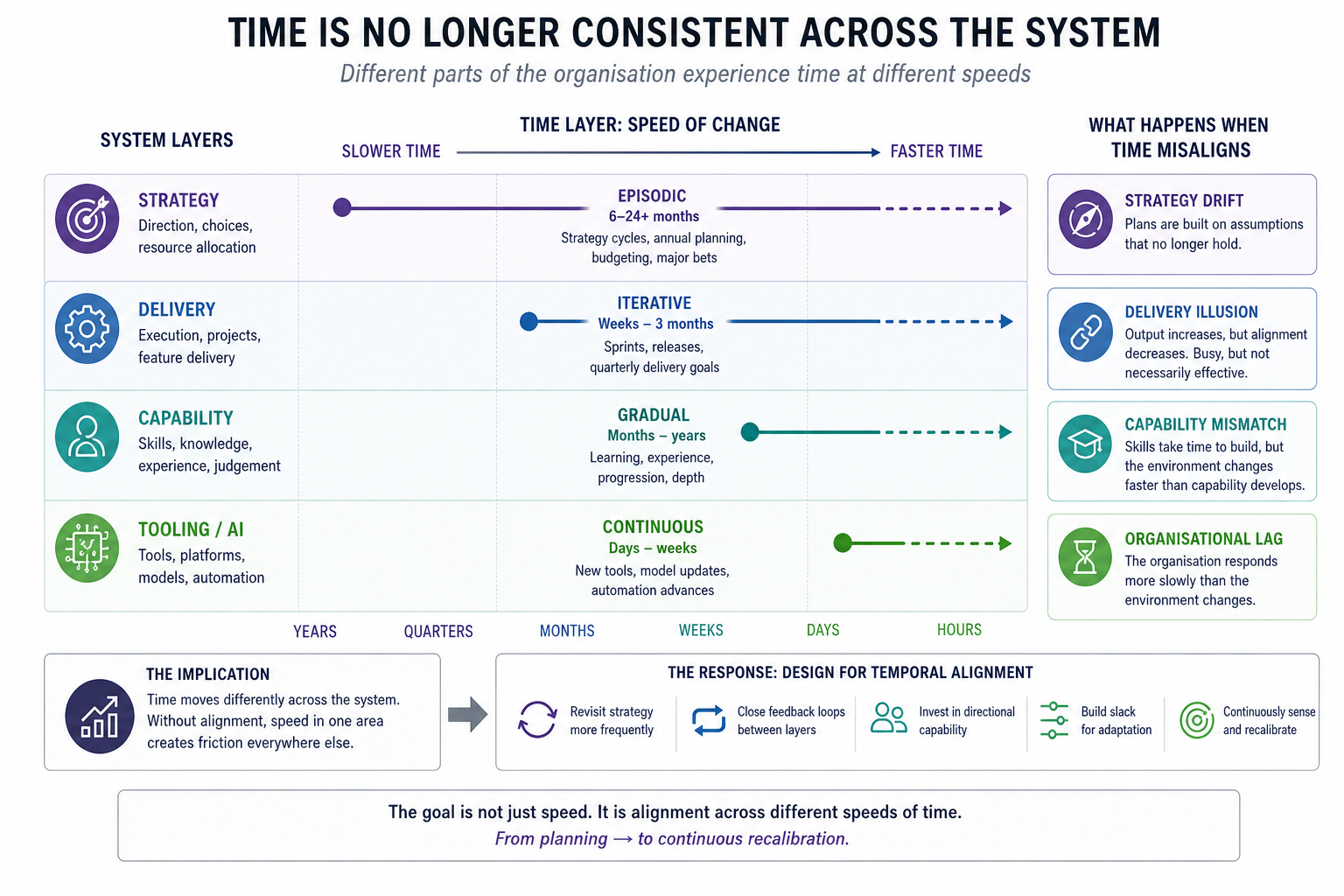
The system vs time layer problem
This leads to a more structural way of thinking about it.
Organisations are composed of different system layers:
- Strategy
- Delivery
- Capability
- Tooling
Each of these layers operates on a different time horizon.
Historically, those horizons were close enough that the system held together.
That is no longer true.
Now you have:
| System layer | Time behaviour |
|---|---|
| Tooling / AI | Rapid, continuous change |
| Delivery | Iterative, short cycles |
| Capability | Gradual, cumulative |
| Strategy | Episodic, slower |
The problem is not that any one layer is wrong.
It is that:
The time characteristics of these layers are diverging.
What breaks when time diverges
When these layers fall out of alignment, a number of failure modes emerge.
1. Strategy drift
Plans are built on assumptions that no longer hold.
By the time execution catches up, the environment has shifted.
2. Capability mismatch
Teams invest in developing skills that are no longer as relevant as expected.
Or fail to develop skills that become critical.
3. Delivery illusion
Output increases, but alignment decreases.
Teams ship more, but not necessarily in the right direction.
4. Organisational lag
The organisation responds more slowly than the environment changes.
Individuals adapt faster than the systems they operate within.
Faster execution, weaker alignment
This is the uncomfortable trade-off that AI introduces.
You can:
- Build faster
- Ship faster
- Iterate faster
But without corresponding changes to how you plan and reassess, you risk:
- Moving quickly in the wrong direction
- Or constantly correcting course
Speed increases, certainty decreases.
The need for temporal alignment
This suggests a different kind of design problem.
Not just:
- What should we build?
- How should we structure teams?
But:
How do we align systems that experience time differently?
A few implications follow:
-
Strategy needs to be revisited more frequently
Not just annually or quarterly, but as a continuous process -
Capability development needs to be directional
Aligned to where the environment is heading, not where it has been -
Delivery systems need to incorporate feedback loops
So that output informs direction, not just execution -
Organisations need space to adapt
Without slack, adaptation does not happen
From planning to recalibration
One way to think about this shift is:
- From planning to recalibration
Planning assumes a relatively stable target.
Recalibration assumes the target is moving.
The question is no longer:
Did we execute the plan?
It becomes:
Are we still aiming at the right thing?
A different kind of capability
This also changes what we value in individuals and teams.
Not just:
- Execution
- Expertise
But:
- Judgement
- Pattern recognition
- The ability to operate across shifting contexts
These are the capabilities that allow systems to adapt when time itself becomes inconsistent.
A transition, not a conclusion
This is still emerging.
Most organisations are operating with models that assume more stable time dynamics than they are now experiencing.
The result is friction.
- Between speed and direction
- Between capability and relevance
- Between planning and reality
The organisations that navigate this well will not just be the ones that adopt AI fastest, they will be the ones that also understand how time is changing, and (re-)design their systems accordingly.